
Allende-The Tears of Chilean People
“Santiago is raining, Macondo, don’t cry for me.” This quote, drawn from the pen of Colombian magical realist writer Gabriel García Márquez, is often used to describe the tragic story of Salvador Allende, the president of another Latin American country, whose controversial political practices sparked widespread debate within the socialist camp. As the first Marxist president in Latin American history to be democratically elected, Allende sought to pursue a “non-violent, legal transition” to socialism, aiming to achieve it through a planned economy and structural reforms while maintaining parliamentary democracy.
Historical Context and Socioeconomic Inequalities
To brief with, since the 1920s, Chile had maintained a tradition of parliamentary democracy and regular elections, with no significant electoral dominance by any ideological faction. However, its socioeconomic landscape was far less balanced than its electoral system. In rural areas, the top 2% of large estates controlled over 55% of arable land, while urban industries and finance were dominated by a handful of monopolistic capitalists. Consequently, calls for reform came not only from workers and peasants but also from urban middle-class citizens burdened by inflation and economic pressures.
With such premises, Allende ran in the 1970 presidential election, narrowly securing victory over right-wing candidate Jorge Alessandri. To avoid a repeat of his 1964 defeat, which was influenced by U.S. interference, Allende struck a deal with the centrist Christian Democratic Party, pledging to uphold constitutional governance, refrain from interfering with parliamentary democracy, and avoid politicizing the military. This agreement helped him thwart a CIA-orchestrated preemptive military coup, allowing him to take office in November 1970.
Forming the Popular Unity Government and Initial Reforms
<https://canadiandimension.com/articles/view/can-allende-make-it>
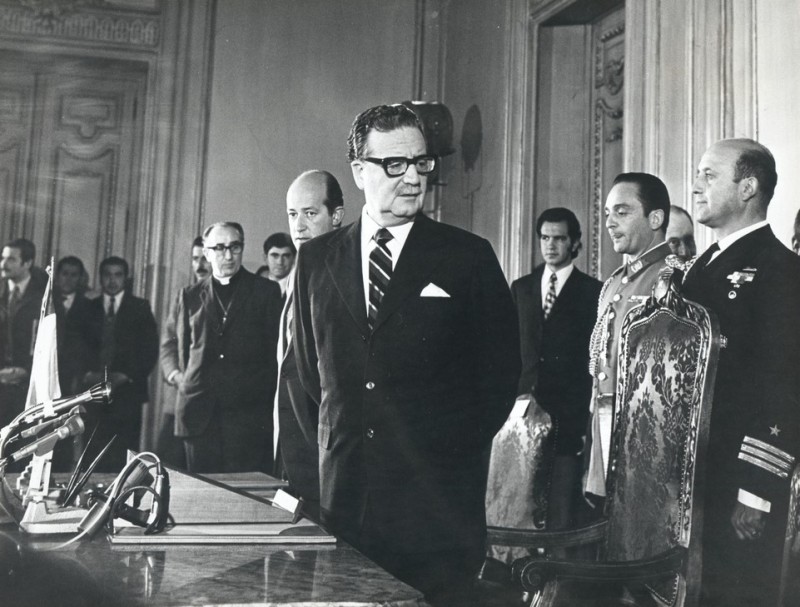
Once in power, Allende formed the “United Popular” coalition government (formerly known as FRAP), declaring that Chile would pursue a peaceful transition to socialism. In 1971, his administration swiftly implemented economic restructuring, with the nationalization of key industries, particularly copper mining, at the core of its economic policy. Chile’s economy heavily relied on copper exports, yet most large copper mines were controlled by U.S. industries. Allende’s government nationalized these mines, viewing it as a critical step toward economic independence and social justice. In July, Chile’s Congress unanimously passed a constitutional amendment authorizing the state to expropriate large copper enterprises without compensation, significantly boosting national pride and support for the government. Banks, telecommunications, and other key sectors were also gradually nationalized or brought under strict state control. Similar policies were applied in agriculture, where the government accelerated the expropriation and redistribution of large estates to landless and smallholder farmers, organizing them into cooperatives. This aimed to dismantle the traditional feudal estate system, increase agricultural productivity, and gain support from the rural poor.
These radical policies brought brief euphoria, but with soaring wages outpacing production capacity, prices skyrocketed. By 1972, inflation surged to triple digits, reaching around 140%. Consumer goods, including staples like flour, sugar, and cooking oil, became scarce, forcing citizens to queue for rationed essentials. Price controls fueled black-market trading, further disrupting the economy.
Meanwhile, Chile’s economic reliance on international markets exposed its vulnerabilities. Over half of its export revenue came from copper, but global copper prices plummeted from $66 per ton in 1971 to $48 within two years, slashing Chile’s foreign exchange earnings. Rising domestic demand and agricultural shortfalls increased imports of essentials like food, exacerbating trade deficits and foreign exchange shortages. The U.S. eagerly exploited this, launching a destabilization campaign against Allende’s government after his election. President Nixon and Secretary of State Kissinger openly vowed to prevent Chile from becoming socialist, implementing a policy to “make the economy scream.” The U.S. pressured international institutions like the World Bank and IMF, along with Western allies, to cut off loans to Chile, crippling its credit and foreign exchange access. Trade embargoes targeted Chilean copper exports, and prior U.S. wheat aid was halted, worsening economic and food shortages. The CIA also funneled significant funds to opposition media to fuel anti-government propaganda and panic, while the U.S. embassy maintained close ties with Chilean military leaders to pave the way for a coup.
The Onset of Economic Crisis
Under these pressures, Chile’s traditional landowners, industrial oligarchs, and financial elites united to oppose the government, deliberately reducing production or hoarding goods to undermine price controls. Shortages of consumer goods drove the middle class to protest, with large-scale demonstrations erupting in Santiago and other cities between 1971 and 1972. The Catholic Church also turned against Allende, accusing his reforms of threatening traditional religious and moral order.
The economic crisis quickly escalated into a political one. With covert U.S. funding, conservative opposition groups organized massive strikes to paralyze the economy. On October 9, 1972, the National Confederation of Truck Owners launched a 24-day anti-government strike involving 40,000 drivers, crippling transportation and logistics. Facing this crisis, Allende’s government compromised with the military, declaring a state of emergency in 18 provinces, transferring security powers to the armed forces, and appointing Army Commander Carlos Prats as Interior Minister to secure military support. However, the government also broke its commitment to peaceful constitutional governance by arresting strike organizers, accusing them of illegal and subversive activities. The strike caused severe economic losses and social unrest, eroding Allende’s public support and setting the stage for a military coup.
The 1973 Coup
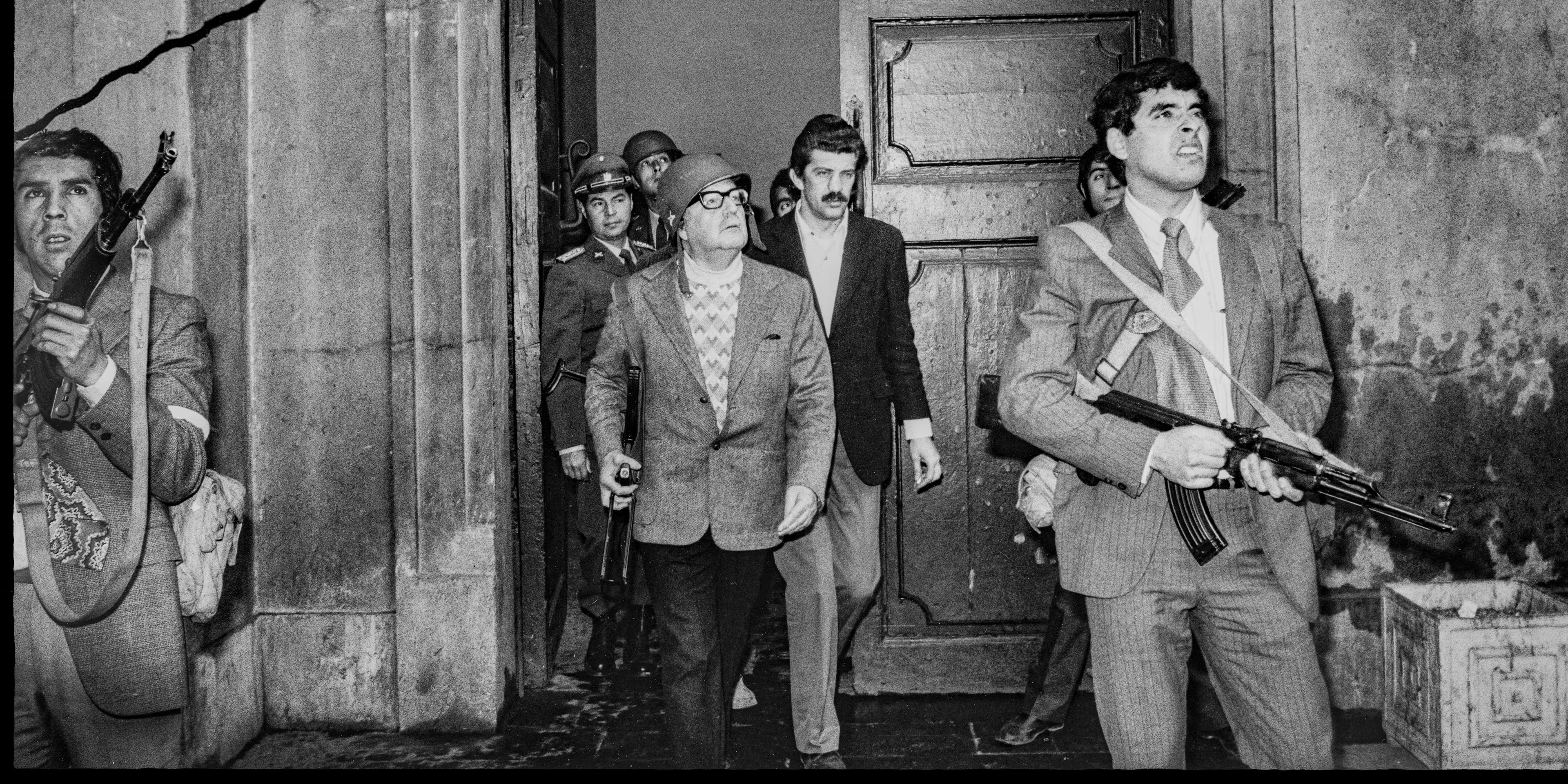
In June 1973, Colonel Roberto Souper led a failed coup attempt known as “El Tanquetazo.” By August, the right-wing-controlled Chamber of Deputies passed a resolution condemning Allende’s government for “undermining constitutional order,” providing a political pretext for military intervention. On the morning of September 11, 1973, General Augusto Pinochet, with U.S. acquiescence and support, led a swift military coup. Tanks, armored vehicles, and fighter jets surrounded and bombed the presidential palace, La Moneda. Allende delivered his final speech from the palace before dying in the assault. The military declared a nationwide state of emergency, dissolved Congress, banned leftist parties, suppressed workers’ organizations, and established a 17-year authoritarian dictatorship.
Warnings, Reflections, and Strategic Lessons
In fact, as early as late 1971, during a visit to Chile, Cuban leader Fidel Castro subtly warned the Chilean left to beware of imperialist subversion and strengthen armed self-defense. He urged Allende to arm workers and purge pro-U.S. elements from the military. However, bound by his constitutional commitments, Allende rejected widespread arming of the populace. After leaving Chile, Castro predicted, “We support Chile’s peaceful revolutionary path, but imperialism will not let it proceed peacefully.” History proved him right: Allende’s government, radical in economic policy but conservative in revolutionary strategy, could not withstand Pinochet’s military coup. Later, Chilean Communist leader Luis Corvalán, imprisoned after the coup, reflected, “We paid the price for our allies’ adventurism, while Allende was still talking about being betrayed by the constitution.”
The choice between political or economic approaches, violent revolution or legal struggle, has been a perennial dilemma for socialist movements since the Russian Revolution. In Latin America, the line between boldness and recklessness, compromise and appeasement, is often razor-thin. It’s akin to the classic optical illusion of “two faces or a vase”: one sees either the faces or the vase, never both simultaneously---one must choose, but choosing one does not erase the other. Allende opted for radical economic reforms in lieu of political actions, such as purging pro-U.S. military factions or suppressing conservative citizens. Here, perhaps Slavoj Žižek’s maxim, “I would prefer not to,” is more pragmatic. For Latin American socialist regimes, “too far from paradise, too close to the U.S.,” pursuing economically pure socialist policies like widespread nationalization often takes a backseat to the more pressing and daunting task of ensuring regime survival. In Chile’s case, with limited external socialist support, a weak industrial base, and heavy reliance on exports, U.S. sanctions and blockades were devastatingly effective. Engaging in strategic maneuvering---not only against external capitalist forces like the U.S. and its allies but also with domestic capitalist interests---might have been a more realistic path. This maneuvering would mean taking one step back through compromises with the bourgeoisie while taking two steps forward by securing control over the means of production to avoid being fully subsumed by capitalist dynamics and ensuring long-term regime stability. Ultimately, the story of a “democratic” socialist president who rose peacefully, governed constitutionally, and met a tragic end is not as precious as a socialist regime that could have endured to this day.