
Climate as Counterinsurgency: JET-P and the Logic of Green Domination
At the 2021 Glasgow Climate Summit (COP26), the host UK government and its G7 allies staged a grand performance: global capitalist elites convened to mobilize fiscal resources and deliver a systemic solution to the global energy transition.
The pre-summit COVID-19 response had already been an embarrassing failure, making COP26 a critical opportunity to restore credibility and showcase elite leadership. The Glasgow Financial Alliance for Net Zero (GFANZ), a spotlight NGO, seized the moment. Led by former Bank of England Governor Mark Carney, it touted a G7 climate alliance commanding trillions in financial assets. As reported in press releases:
These commitments, from over 450 firms across 45 countries, are expected to provide the roughly $100 trillion needed for net-zero emissions over the next 30 years. To support this capital deployment, the global financial system is being transformed through 24 major initiatives introduced at COP26, significantly strengthening the information, tools, and markets required to support the global economy’s transition to net zero.
The era of global energy transition became a political stage for the climate alliance. The multilateral agreement known as the Just Energy Transition Partnership (JET-P) garnered high-level political support. These partnerships aim to address major barriers to energy transition in developing countries through external investment, paired with social equity measures to ensure all key stakeholders are engaged.
Announced at COP27 in November 2022, JET-P outlined the funding scale and scope required for decarbonization agendas. A prime example is South Africa’s decarbonization target. To transform its electricity structure, South Africa requires over $99 billion by 2027, driven by its heavy reliance on coal-fired power from the late apartheid era. This dependency places South Africa’s carbon emissions 14th globally, despite its population not ranking in the top 20. At COP27, South Africa secured an initial $8.5 billion in startup funds through JET-P agreements with developed nations.
Following South Africa, countries like India, Vietnam, and Indonesia announced similar projects. What a promising future! Surely, the G7’s global bourgeois elites, through collaboration with the Global South, could resolve the “develop first, govern later” dilemma. After all, every G7 member has presumably overcome colonial exploitation, overdevelopment, and inefficient investment, now cruising down the path of green transition and North-South cooperation.
Yet, South African government estimates reveal a transition need of $98.7 billion for 2023–2027, far exceeding international support. Of the initial $8.5 billion pledged, only $0.3 billion was grants, with the rest as concessional and commercial loans— familiar to anyone from Greece. To bridge the gap, international partners added funds: $0.3 billion in loans from the African Development Bank, $1 billion from the World Bank, and €0.5 billion from Germany’s KfW. By 2024, the JET-P funding pool grew to $11.6 billion, still less than 15% of the total need, with the U.S. having withdrawn from the plan.
Over nearly three years, no substantial progress emerged: no major investment projects or social packages, no tangible shift from coal to renewables, and no significant political capital gained.
Similarly, on November 16, 2022, Indonesia and international partners launched the Indonesia Just Energy Transition Partnership during the G20 Summit. Initially promising $20 billion, the commitment grew to $21.6 billion, hailed as the world’s largest energy transition financing plan to date.
In Indonesia, the funding shortfall is equally glaring. According to CIPP estimates, achieving investment targets in five key areas (transmission and grid, coal plants, dispatchable renewables, variable renewables, and renewable supply chains” target=“_blank” rel=“noopener noreferrer”> by 2030 requires $97.3 billion, yet only $11.5 billion in public funds has been committed. JET-P’s de-risking funds are minimal, and concessional loans with attached conditions heighten debt risks, as noted in an ODI report:
Regardless of how profit-driven private finance operates, fiscal constraints remain insurmountable. The forces of global development lack the clout of military-industrial complexes, oil, gas, or Wall Street networks. The result is ambitious, expertly designed policies that excite analysts, think tanks, NGOs, and experts but fail to impact either stated policy goals or Western capital’s profit opportunities. Meanwhile, other interest groups in these powers are unwilling to support this elite-led global order with funds or resources, preferring to exit it outright or indirectly through “dollar dominance,” energy supply control, or harsh measures like military force.
“No Competition” Matters to the G7
Empty promises are not new for Western financial groups. At the 2009 Copenhagen Climate Summit, amidst criticism of China and India for rejecting a global climate agreement, UK Prime Minister Gordon Brown and U.S. Secretary of State Hillary Clinton pledged $100 billion for climate finance to save face. Over the past decade, developed nations have repeatedly failed to deliver—not just on climate finance but also on global sustainable development.
At COP28 in late 2023, South Africa’s JET-P was assessed by two entities: the UK’s Overseas Development Institute (ODI) and the Rockefeller Foundation. The ODI report offered a critical, quasi-academic evaluation, while the Rockefeller Foundation’s report merely showered praise, noting six high-level meetings since JET-P’s inception, concluding with little substance. Beyond dry propaganda, the Rockefeller report contains revealing insights:
A vast gap persists between global climate action goals and the actual pace of national transitions, especially in emerging and developing countries. Moving away from fossil fuels requires rapidly scaling up renewable energy use. Yet over 90% of new renewable energy spending flows to developed nations and China. Addressing this imbalance and delivering clean energy to those most in need requires building domestic ecosystems to accelerate this shift. This means fostering local expertise, strengthening institutions, engaging civil society, utilities, and regulators, developing robust transition plans, and attracting diverse external capital. The Just Energy Transition Partnership (JET-P) is a promising political and financial innovation to tackle this challenge. These arrangements, led by donor International Partner Group (IPG) countries, combine high- level political support with concessional capital to target short-term investments, focusing on mitigating challenges for industrial workers in the energy transition.
While the data on over 90% of renewable energy spending flowing to developed nations and China is accurate, the conclusion distorts the imbalance. According to 2024 International Energy Agency data, China accounts for ~40% of global renewable energy investment, while the U.S. and EU, which should lead green reforms based on energy consumption, lag significantly.
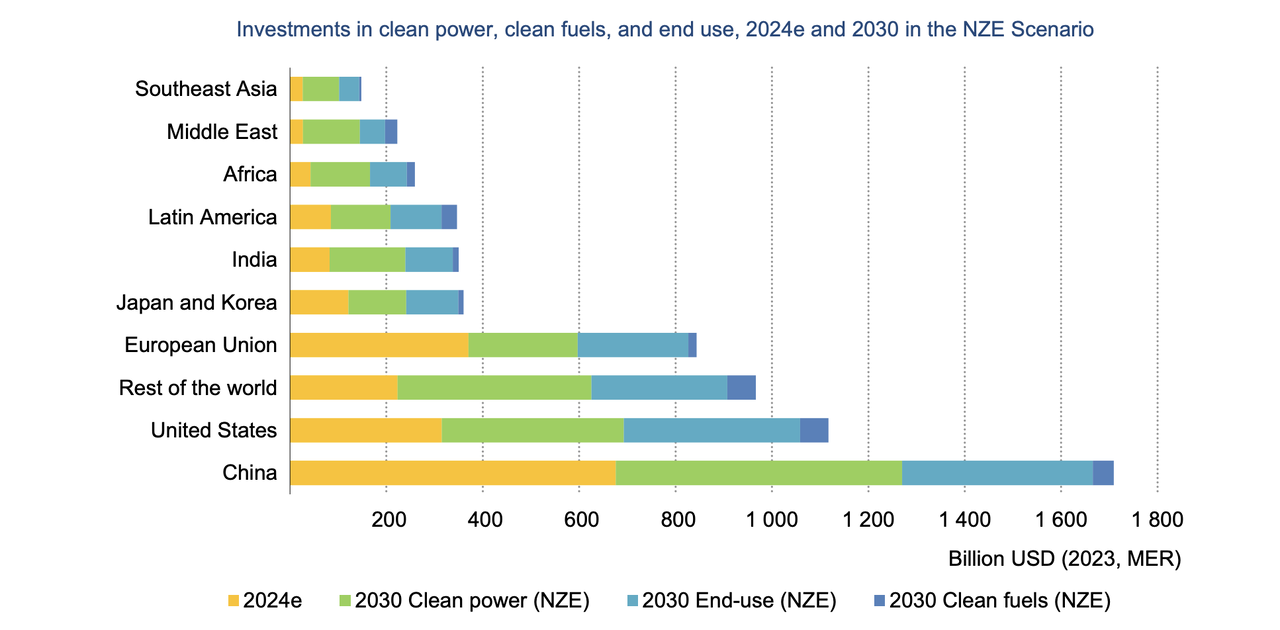
Under initiatives like the Belt and Road and dual-carbon commitments, China invests heavily in infrastructure and environmental projects in specific Global South countries, making it the largest provider of bilateral investment projects and a leader in global renewable energy investment and technology. This influence alarms traditional capitalist powers, who view it as a challenge to their “hegemonic” leadership. Like using tariffs to provoke, climate finance becomes a tool to counter the Belt and Road by crafting a “justifiable” otherness.
Table 1. South Africa JET IP funding requirements per sector, 2023–2027
| Funding requirements 2023–2027 | ZAR billion (USD billion) |
|---|---|
| Electricity sector | 711.4 (47.2) |
| New energy vehicle sector | 128.1 (8.5) |
| Green hydrogen sector | 319 (21.2) |
| Skills development | 2.7 (0.18) |
| Municipal capacity | 319.1 (21.3) |
| TOTAL | 1,480 (98.7) |
Source: The Presidency, Republic of South Africa, 2022.
South Africa’s official estimates highlight a massive funding gap, with grants comprising less than 5% of commitments. Even the modest paper achievements are problematic, with much of the funding merely rebranded existing investments. In total, JET-P funds for South Africa amount to less than one-tenth of the need.
Beyond funding shortfalls and inefficiencies, local livelihood development is critical. Despite UNDP’s labor retraining plans, only 23% of Indonesia’s coal workers received renewable energy skills training, and compensation standards exclude informal workers (41% of the sector). Compared to Ireland’s peatland transition, JET-P lacks a spatial justice framework or plans to address regional economic imbalances. Worker training, one of the few benefits capitalisms offers the Global South, enables local labor to gain skills with advanced tools and production clusters, improving community economies. Yet, for various reasons, developed nations have abandoned training, viewing it as a threat. The U.S. International Development Finance Corporation (DFC) exemplifies this, using environmental and labor rights issues to sideline Chinese firms, only to shift to fully mechanized operations that cut local jobs.
This demands a reevaluation of JET-P’s framework and model, returning to its core: What is JET-P?
Table 2. South Africa JETP Initial Funding Structure
| Entity | Grants/Technical Assistance (USD billion) | Concessional Loans (USD billion) | Commercial Loans (USD billion) | Guarantees (USD billion) |
|---|---|---|---|---|
| CIF/ACT* | 0.5 | 25.55 | 0 | 0 |
| European Investment Bank (EU) | 0.35 | 10.0 | 0 | 0 |
| France | 0.025 | 10.0 | 0 | 0 |
| Germany | 1.98 | 7.7 | 0 | 0 |
| United Kingdom | 0.24 | 0.0 | 5 | 13 |
| United States | 0.2015 | 0.0 | 10 | 0 |
| Total** | 3.297 | 53.25 | 15 | 13 |
| Share (%) | 3.9% | 62.98% | 17.71% | 15.38% |
The International Partner Group (IPG), comprising the UK, U.S., France, Germany, and the European Commission, backs JET-P, notably excluding China—the leading Global South partner and largest provider of renewable energy technology. A Shanghai Institute for International Studies article by Yu Hongyuan and Wang Xinyu cuts through the Rockefeller report’s ambiguity: “Club-style partnerships will be a key tool for the U.S. to reclaim strategic dominance.”
Conclusion
Not only is JET-P’s investment insufficient, but its energy transition vision is flawed. The Glasgow agenda fixates on phasing out coal, sparking prolonged disputes with Indonesia. While relevant to South Africa’s context, for most of the Global South, shutting down high-pollution coal plants is seen as the Global North cutting energy access for already underserved populations. For most low- income countries, closing coal plants offers no tangible benefit.
If energy transition were easy, recipient nations wouldn’t need partnerships. JET-P’s stated goal is to overcome entrenched fossil fuel interests, particularly coal, through targeted aid and high- level political commitment. But this requires scale and impact, which JET-P has failed to deliver. We stand at a crossroads: either economic-ecological transition is a false premise, or it’s achievable. Supporting the latter requires alternative models and partnerships built on mutual benefit and feasibility. Nations and organizations willing to implement such alternatives could thrive, but the G7 instinctively rejects them.
Western climate action, at its core, is financial imperialism draped in green. The EU’s Carbon Border Adjustment Mechanism (CBAM) acts like Huang Silang’s fortress cannons, seizing control over developing nations’ emissions pricing rights. When Germany demands Vietnam’s JET-P funds buy Siemens equipment, “just transition” becomes the strong taming the weak. This violence manifests in narrative dominance: developed nations, responsible for 77% of historical global emissions, demand equal reduction burdens from developing countries; the U.S., having exited the Paris Agreement, accuses China of excessive emissions. Historical bullets fly across Glasgow’s negotiation tables, loaded not with net-zero promises but with the smoke of control.
Appendix: Financing Cost Characteristics of JET-P Projects
-
Cost Layering in Blended Financing Models JET-P employs a “public funds + private capital” model, with grants comprising less than 15% of public funds, the rest being concessional loans or guarantees. For Indonesia’s JET-P, of the $21.6 billion committed, only $144.6 million (0.7%) is grants, with concessional loans (2–3% interest) at ~32% and commercial loans at 5– 7%. South Africa’s initial $8.5 billion JET-P funds included just 3% grants, with the rest as loans at 5–8% interest.
-
High Return Demands of Private Capital The $10 billion in private capital (e.g., via GFANZ) demands market-based returns. In Indonesia’s JET-P, private capital expects internal rates of return (IRR) of 12–15% for renewable projects, significantly higher than the 6–8% for public funds.
-
Hidden Costs and Implementation Inefficiencies Delays in fund disbursement and policy coordination inflate costs. In Indonesia’s JET-P, only 12% of funds have been disbursed, with 60% of allocated funds spent on pre- project assessments and technical assistance, increasing overall financing costs by ~2–3%.
Reference
-
Adam Tooze, “The Paper Tiger of Western Climate Geopolitics: The Just Energy Transition Partnership (JETP),” Chartbook, translated by Liu Xilai.
-
Institute of Energy, Peking University, “Analysis of the Progress of the JETP and Its Implications for China’s International Cooperation Strategy,” Climate Change and Energy Transition Project.
-
International Energy Agency (IEA), World Energy Investment 2024.
-
Government of South Africa, Just Energy Transition Investment Plan (2023–2027), November 2022.
-
Anissa Suharsono and Martha Maulidia, “What Indonesia Can Learn from South Africa’s Just Energy Transition Process?”, International Institute for Sustainable Development (IISD), July 2023.
-
Dauthau, “Ba Ria–Vung Tau Province: Selection of Investor for a VND 2.5 Trillion Waste Treatment Plant Project,” Vietnam National Tender Information Portal.
-
“COP26: Implications of Climate Finance, Net- Zero Alliances, and Sustainable Financial Systems,” Carbon Trading Platform (WeChat publication).