
Japan’s Anti-Colonial Power in View of U.S. Military Sexual Violence in Okinawa
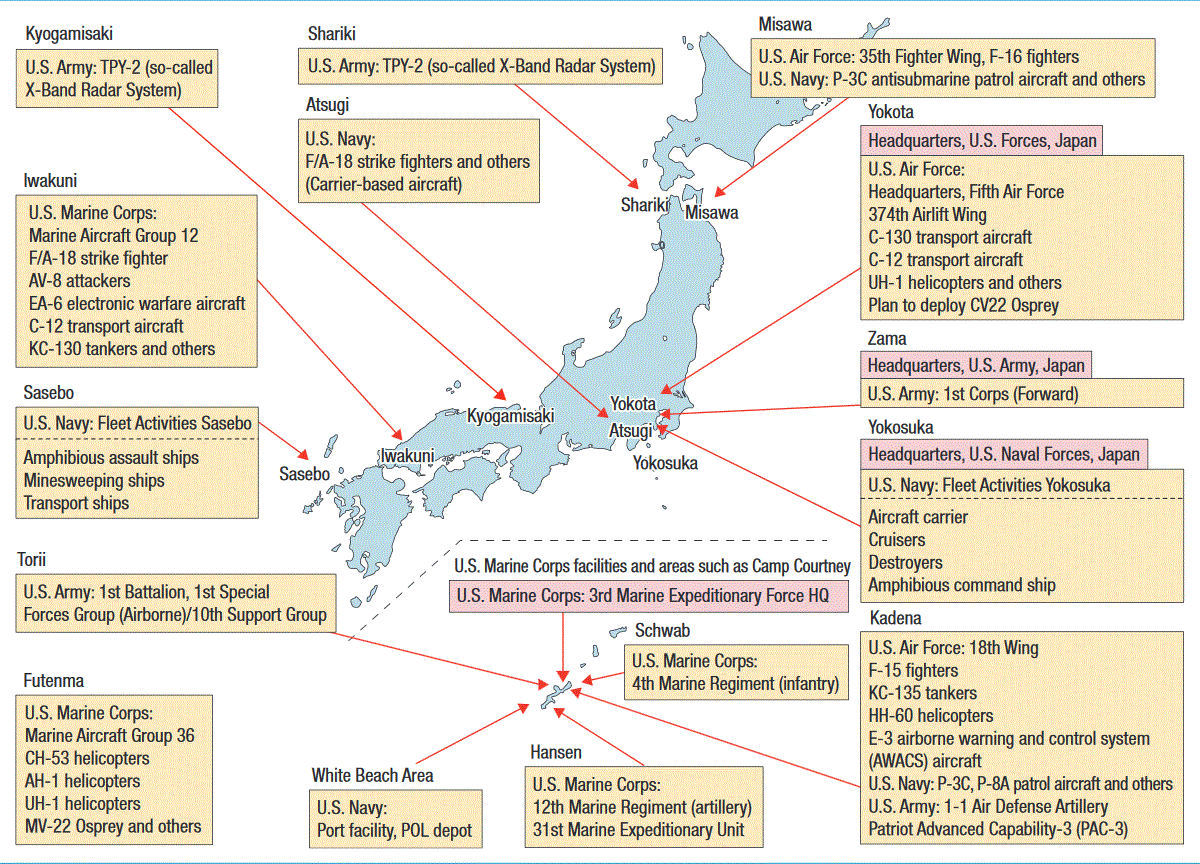
For a long time, U.S. military bases abroad have been the most naked symbol of imperialist colonial rule around the world. In Japan in particular, the social problems brought about by the U.S. military have become widespread social issues. As of January 2025, the U.S. has more than 130 military bases in Japan, 81 of which are dedicated to the U.S. military, including the Air Force, Navy, and Marine Corps. Japan also has the largest number of U.S. military bases and population in East Asia, and is a key pivot for the U.S. to maintain its imperialist hegemony in the Asia-Pacific region. These military bases have had far-reaching negative impacts on the lives of the local population, and in recent years the frequency of sexual violence cases has raised concerns among the Japanese people. This article focuses on the recent protests against U.S. military misconduct in Japan and exposes the imperialist rule behind the atrocities.
History of Sexual Violence by U.S. Troops in Japan
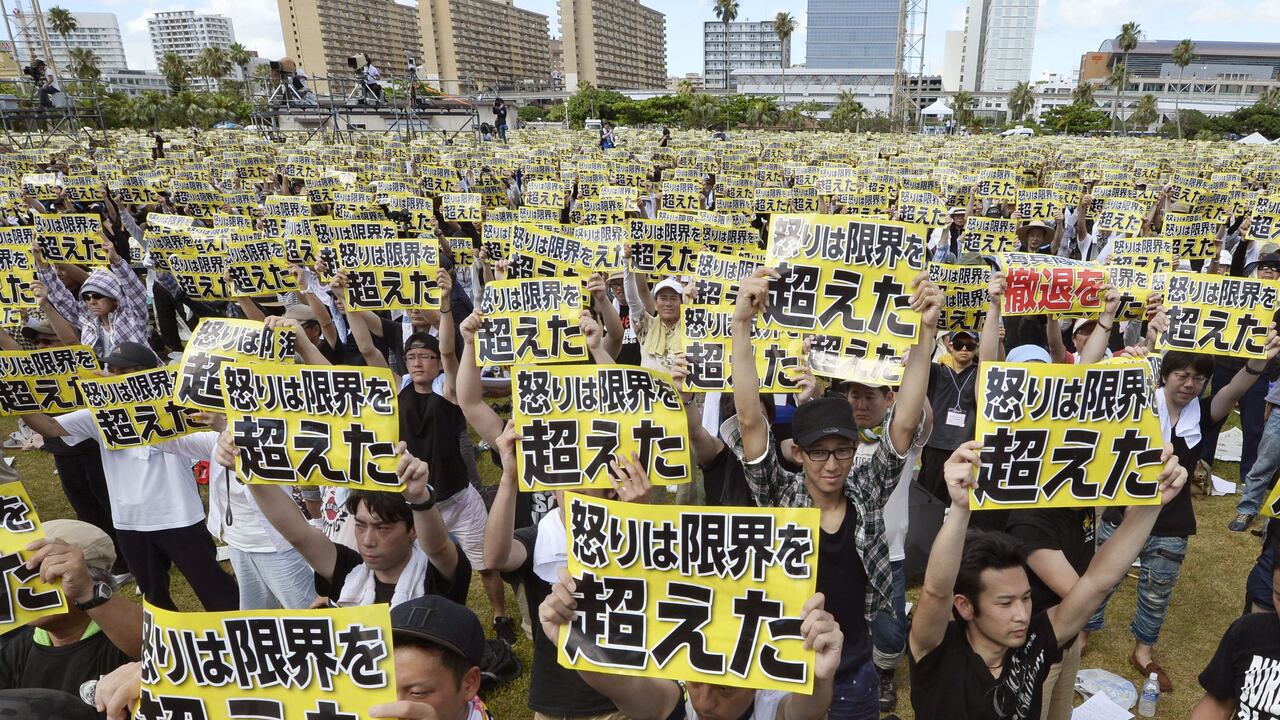
In December 2023, a U.S. soldier at the Kadena Air Force Base in Okinawa, Japan, abducted a 16-year- old girl from his home and raped her, who reported the incident to local law enforcement. In October 2024, prosecutors recommended a seven-year prison sentence, but the defendant and his defense attorney argued for acquittal. In the end, the Naha District Court sentenced the soldier to five years in prison, which the defendant protested and appealed. The verdict immediately provoked strong resentment among the people of Okinawa, and on December 22, 2024, more than 2,500 citizens organized themselves into the Okinawa Prefectural People’s Assembly to protest the atrocities committed by the U.S. soldiers and the weak response of the Japanese government. At the same time, people in Tokyo and other places also joined the protest, targeting the long-standing illegal behavior of the U.S. military in Japan.
It is worth noting that although sexual violence by U.S. troops in Japan has become a long-standing social problem, most of the perpetrators have not been duly punished. According to various Japanese media reports, in 2024 alone, local authorities in Okinawa received three allegations of sexual violence against U.S. soldiers, but two of them were concealed by law enforcement agencies and not disclosed to the public. In fact, since Okinawa’s reunification with Japan in 1972, U.S. troops and their dependents have committed about 6,200 criminal cases in Okinawa, many of which involved rape, murder, robbery, and other vicious incidents. For example, in 1995, three U.S. soldiers kidnapped and raped a 12-year-old Japanese elementary school student, but the U.S. military once refused to hand over the accused to the Japanese court for handling.
Similar cases occurred in 2001, 2003, and 2016, but only a handful of cases have been successfully prosecuted. The Opinion adopted by the Okinawa Prefectural People’s Assembly explicitly calls for a thorough revision of the Japan-U.S. Status of Forces Agreement (SOFA) to address the special legal status of U.S. troops and their dependents in Japan. Since the U.S.-Japan Security Treaty came into effect in 1960, this legal framework has allowed U.S. military personnel to avoid Japanese jurisdiction in the face of serious charges. Despite repeated large-scale protests by Okinawans, the Japanese government has failed to take effective measures in response. This situation not only highlighted the structural inequality in Japan-U.S. relations, but also reflected the U.S. strategic need to maintain its imperialist hegemony in East Asia. The Japanese bourgeois government had long used the “Japan-U.S. Alliance” and the “U.S. Protection Doctrine” as the core of its propaganda in an attempt to shape the relationship between the two countries into a partnership of equality and mutual benefit. However, the frequent criminal behavior of U.S. troops in Japan and their privilege of not being bound by local justice directly exposed Japan’s subordinate position in the Japan-U.S. relationship.
Japan under the Imperialist Order
Imperialist designs in East Asia have long been no secret. Since the end of the Cold War, the United States has been relying on the first island chain to carry out direct or indirect military intervention in the entire Asia-Pacific region.
As an outpost of its global hegemony, the military deployment of imperialist forces in various countries or regions in East Asia is based on the manipulation of regional political and economic entities. As a developed capitalist country and the world’s fourth largest economy, Japan, on the one hand, obtains cheap raw materials and resources from Third World countries through multinational enterprises, and on the other hand, its international status is always subjected to the constraints of the imperialist core countries. Japan nowadays is in the paradoxical position of playing dual roles in the global capitalist division of labor system. The constraints of the financial system controlled by the imperialist countries, led by the United States, made it necessary for Japan to develop its technological and capital advantages by obeying the rules set by imperialism. Japan’s position in the imperialist order was mainly characterized by its dependence and its role as an intermediate link in the colonialist oppression of the Third World countries. In the Okinawa Incident, the Japanese government once again demonstrated a weak and compromising attitude in the face of the public’s clamor and the denunciation of injustice. The longstanding policy of the bourgeois government fully demonstrates that this behavioral strategy is rooted in the inevitable consequences of its class position.
As a deeply embedded part of the global capitalist system, Japan’s bourgeois government is in a secondary position in the imperialist order, unable to challenge the dominance of the core countries but also dependent on the system to maintain the interests of its own capitalist group. Therefore, both the concessions in trade agreements and the long-term dependence on the U.S. military in terms of military security were the inevitable choices of the bourgeois government in the international competition for capital. Even though Japan’s domestic capital was in competition with the capitals of other countries, the bourgeois government was more inclined to sacrifice national autonomy in exchange for economic shares in the global market under the framework of the imperialist system. Such concessions to international capital would eventually be transferred to the Japanese working people through austerity policies, labor market liberalization, and other means, further deepening the social conflicts in the country.
Who will lead the revolution?
The huge voice that was raised in this protest is a good example of the great political power of the people of Okinawa, who are under the oppression of colonialism. However, in the absence of a leading organization, it is impossible to expel the imperialist forces by mere spontaneous actions. It is true that the actions of the Okinawan people have received widespread attention and support from civil society throughout Japan, but this support is generally characterized by petty bourgeoisie, with humanism and pacifism as the mainstay, and even the view that the atrocities were attributed to the personal actions of the American soldiers, and that they were expected to be moderated by Japan and the United States. Such words deeply reflected the class characteristics of the petty bourgeoisie, which ignored the real nature of imperialist oppression and stopped resistance at the illusion of national security. Unbeknownst to them, the reason for the recurrence of such tragedies was the total interference of the US in Japan’s political and military affairs and its attempt to use it as a springboard to gain control over the whole of East Asia.
Therefore, the anti-colonialist struggle in Japan could not be led by the petty bourgeoisie. Faced with the conspiracy of interests between the Japanese bourgeoisie and the imperialist forces, the liberation of Okinawa and even the whole of Japan had to be led by the proletariat, which was most directly oppressed by imperialism. With the internal defeat of the imperialist countries, their control over the East Asian region was loosened, which provided a historical opportunity for the liberation struggle of Japan. As the core of imperialism, led by the United States, was unable to maintain its solid position in the world, Japan was likely to become the new balance of power in the First Island chain. With the prospect of imperialism gradually losing its direct jurisdiction over Japan, the Japanese bourgeoisie will lose its dependable channels of capital export and the protection of its high-tech industrial monopoly.
The bourgeoisie would defend their rule through more violent counter-attacks against the revolution, thus suppressing the proletarian revolution. This requires that the proletarian revolution in Japan be led by a revolutionary body with a high degree of organization and rigor. Such a revolutionary body must take socialism as its ideology and insist on resisting all the interference of imperialism. Only in this way can imperialism be completely eliminated by uniting all the liberating forces under the premise of suppressing the bourgeois forces. To this day, there are still many forces in Japanese society that are committed to opposing imperialism and bourgeois rule in Japan. Considering Japan’s position in international geopolitics, its anti-colonial struggle is highly complex. Anti-colonial Vigilance will continue to follow the development of Japan’s anti-colonial struggle, including the changes in class consciousness and power contrasts, and comment on the theoretical and practical paths of various communist organizations. The reader is urged to note that this article is only an introductory one, and will be followed by a series of articles on the communist movement in Japan.