
The Post-Apocalypse under Reformism: The Fragmentation of Present Italy Left
Introduction: The Decline of the Left and the Trap of Reformism
Italy’s left, once centered on the Italian Communist Party (PCI), drew on dense trade-union linkages, cultural infiltration, and class mobilization to stand at the forefront of Europe’s communist movement. After the Cold War, however, the reconfiguration of global capitalism and shifts in Italy’s social structure plunged the left into crisis---marked by ideological drift, organizational fragmentation, and a collapse of political agency. Within this trajectory, the 1995 pension reform became emblematic of the dilemmas facing a reformist left: it neither reconciled internal splits nor adapted to the structural shift of the proletariat from domestic workers to global migrant labor. This essay does not propose ways for the Italian left to transcend reformism, nor speculate on how the Western European left might change the status quo. The first task is to dispel illusions and lay out the facts.
Historical Background: The Left’s Post—Cold War Crisis
The Collapse of the First Republic and a Political Earthquake
By the 1970s, the long-ruling Christian Democracy (DC) had degenerated into a bloated, corrupt bureaucratic bloc. Its base shifted from religious networks and small rural proprietors toward a patronage structure dependent on state subsidies, public-works contracts, and state-owned enterprises. The late-1970s economic crisis and the rise of neoliberalism hit this distorted model hard. High labor costs, massive public debt, and unsustainable welfare expenditures exposed the state’s inability to steer the economy. Patronage exchanges among parties, firms, and local power brokers deepened corruption, evolving into entrenched, systemic bribery.
In 1992, the “Clean Hands” (Mani Pulite) investigation led by Milan prosecutor Antonio Di Pietro uncovered a vast bribery network implicating the entire party system and served as the trigger for the First Republic’s collapse. The end of the Cold War (the Berlin Wall’s fall in 1989) further transformed Italy’s political environment: as a Cold War product, the PCI lost ideological legitimacy, and anti-communism no longer bound the ruling camp. This geopolitical shift---linked to global capitalist restructuring, the collapse of planned economies in Eastern Europe and the Soviet Union, and the crisis of Western European welfare states---signaled a broad retreat of state intervention and collective coordination.
Amid anti-corruption upheavals and international realignment, the April 1992 election for the 11th legislature dealt heavy blows to both the ruling coalition and the opposition, marking the onset of Italy’s political “earthquake.” Voters showed deep distrust of established forces, reflecting the failure of ideological anchors and the breakdown of redistribution.
Electoral Reform and the Reconstitution of the Left
In August 1993, under the impetus of former Bank of Italy governor Carlo Azeglio Ciampi, a national referendum shifted the electoral system from pure proportional representation to a mixed system combining first-past-the-post with proportional representation. The reform sought to break the First Republic’s cycle of “party lock-in---governmental ineffectiveness” and open space for new political forces. However, it also forced the left to adapt to majoritarian logics---moderating its program and recasting its historical identity to court median voters---thereby weakening traditional class identification and ideological mobilization. Under proportional representation, the left relied on unions and class identity to hold stable constituencies; under the new rules, the Democratic Party of the Left (PDS) had to reorient toward the center.
This shift was a passive response to socioeconomic change: the postwar “Fordist working class” that had underpinned the PCI disintegrated through outsourcing, automation, and the expansion of precarious contracts, while service-sector atypical workers, young temporary workers, and women had yet to develop durable channels of political representation.
The 1995 Pension Reform: A Symbol of Left-Wing Division
<https://www.aa.com.tr/en/politics/a-million-italian-workers-protest-labor-reform/107551>
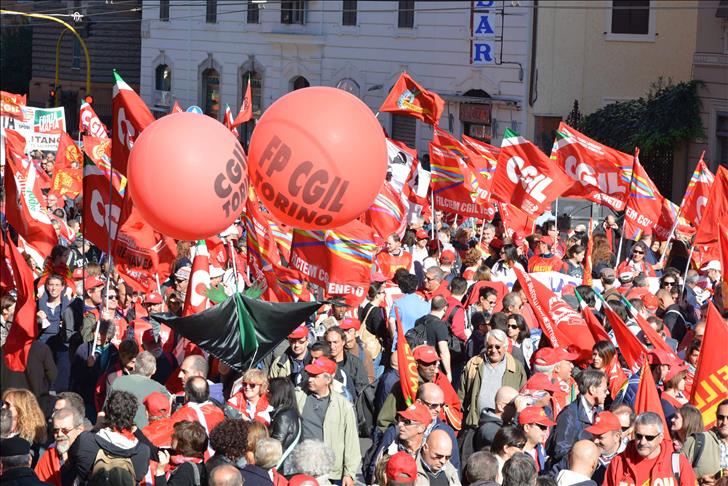
The 1995 pension reform happened under the fiscal pressures of the Maastricht Treaty. It became emblematic of both internal fractures within the left and its reformist impasse. To contain soaring public debt and meet EU requirements, the Dini government advanced reforms that protected privileges for older public-sector workers while shifting burdens onto younger and newly hired workers, thereby deepening intergenerational inequality. The PDS’s support underscored a turn toward technocratic governance---privileging fiscal sustainability over distributive conflict---whereas the Communist Refoundation Party (PRC) opposed the reform to defend welfare measures (including “baby bonuses”) but failed to propose viable solutions to the welfare state’s fiscal crisis.
The reform did not by itself cause the left’s decline, but it laid bare a strategic quandary amid global capitalist restructuring. The PDS—PRC split reflected two paths: integration into neoliberal logics versus adherence to an aging welfare model. Neither tendency confronted a basic fact: the core of exploitation had shifted from domestic workers to migrant labor from the Third World.
The Reformist Path and Internal Splits of the Left
The Olive Tree’s Brief Victory
In 1994, the PDS led the “Progressive Alliance,” abandoning the hammer-and-sickle for an oak emblem meant to signal moderation and environmentalism and to attract centrist voters. The alliance lost the general election to Silvio Berlusconi’s “House of Freedoms coalition”, revealing the left’s powerlessness in the face of capitalist restructuring and social re-stratification. Outsourcing, privatization, and flexible employment reshaped the labor market; youth, women, and informal workers were pushed outside standard employment relations, and the left failed to organize them effectively.
In 1995, under Massimo D’Alema, the PDS formed “The Olive Tree coalition” with moderate ex—Christian Democrats (the Italian People’s Party, PPI) and the social-liberal Italian Renewal (RI), nominating economist Romano Prodi for prime minister. In 1996, the coalition won, achieving the left’s first postwar ascent to power through elections. The PDS sat at the core of the Prodi government, holding key portfolios such as education, finance, and industry, and embodying a compromise between social democracy and market logic: privatizations and fiscal consolidation to satisfy EU criteria alongside attention to public education and women’s issues.
Yet the coalition’s heterogeneity deprived it of a unified social base. The PDS’s detachment from class politics diluted traditional commitments to labor—capital conflict and redistribution. Party membership fell from 1.5 million in 1989 to under 800,000. The PRC’s 120,000 could not compensate for dwindling mobilization. The traditional working class drifted into political apathy or was absorbed by right-wing populism, further fraying the left’s link to its base.
The Transformation to the Democrats of the Left and Further Fragmentation
In 1997, D’Alema advanced an internal motion casting the PDS and PRC as “two irreconcilable lefts,” marking a move from ideological unity to strategic division. At its 1998 Florence congress, the PDS founded the Democrats of the Left (DS), incorporating multiple left and center-left groups, adopting the socialist “red rose,” and definitively abandoning communist symbols. The aim was to build a center-left social-democratic formation, but the shift diluted class positions.
That same year, the Prodi government fell after the PRC exited the coalition. D’Alema became prime minister, leading a center-left government of DS, PPI, and the Party of Italian Communists (PdCI). Despite its symbolism of left return, the D’Alema government continued on a neoliberal course---pursuing fiscal austerity and EU integration---prompting another PRC exit and exposing deep fissures over class commitments.
In 2001, the center-left lost to Berlusconi and entered a long opposition. In 2007, the DS merged with The Daisy to form the Democratic Party (PD), signaling full alignment with European social democracy. This catch-all formation prioritized urban professional strata over class foundations, producing structural alienation from labor, youth, and the lower classes.
The Rise of Right-Wing Populism
Strategic missteps by the left opened space for right-wing populism. Forza Italia and the Brothers of Italy mobilized disaffected middle and marginal groups through anti-establishment, nationalist, and anti-immigrant narratives driven by welfare anxieties and law-and-order concerns. In 2022, Giorgia Meloni’s coalition won a commanding mandate. Left votes narrowed to urban upper-middle constituencies as traditional class bases collapsed.
The right’s strategic acuity lies in stoking exclusion while relying on migrant labor to sustain accumulation. According to INPS (2023), non-EU migrants contribute over €12 billion annually to Italy’s pension system; research by the Fondazione Leone Moressa (2021) estimates that excluding migrants would shrink GDP by 8.7% and create an annual fiscal shortfall of €16 billion. The Meloni government’s plan to admit 500,000 foreign workers in 2026—2028 starkly expresses the contradiction between nationalism and neoliberalism.
Migrant Labor’s Class Position and the Governance Paradox

Amid the restructuring of global capitalism, the traditional class base of the Italian left has undergone a profound transformation. The truly exploited class is no longer the domestic industrial workforce of the national-capitalist era, but rather the migrant labor that keeps the economies of the First World running. Drawn largely from North Africa, sub-Saharan Africa, and South Asia, these workers are concentrated in agriculture, construction, care work, and logistics---sectors marked by low skill requirements, high intensity, low wages, and minimal union coverage. According to 2023 data from the National Social Security Institute (INPS), non-EU migrants contribute more than €12 billion each year to Italy’s pension system. A 2021 report by the Fondazione Leone Moressa further estimated that, if migrants were excluded entirely, Italy’s GDP would shrink by 8.7 percent and the national budget would face an annual shortfall of roughly €16 billion. These figures underscore the economic indispensability of migrant labor. Yet politically these workers remain systematically marginalized---constituting a core component of the system’s functioning while simultaneously being branded an “illegal subject” to be accused and excluded---leaving them without adequate political representation.
After the 2022 election, Italy’s rightward turn made this contradiction more visible. Ideologically, the Meloni government fuels exclusionary populism that scapegoats migrants while its 2026—2028 admission plan aims to ease labor shortages. This governance paradox reveals the hypocrisy of neoliberal nationalism: it depends on migrant labor for accumulation yet maintains an exclusionary politics to preserve an imagined community, extracting higher exploitation through a grey zone of irregular work. Such self-defeating state behavior denies the bases of social reproduction and generates a dual crisis of capacity and legitimacy.
The contemporary left’s response to this class shift remains trapped in the PCI-era habits of parliamentary struggle and the project of welfare-state building. New left forces have long attempted re-unionization and redistribution to fold migrant labor into state frameworks and restore integrative capacity. Yet two binding constraints persist:
-
Structural economic constraints. The welfare state’s fiscal crisis and the breakdown of redistribution mechanisms are precisely why the state turned to cheap migrant labor. Efforts to include migrants within “social citizenship” are impossible from the outset, because capitalism’s logic demands its own reproduction. The goal of “expanding welfare beneficiaries” is intrinsically at odds with the very driver required to realize it---“cheap labor entering from outside.” We must remember: in the First World, welfare is not merely a cost of capital but a necessity for capital’s reproduction.
-
Limitation of political mobilization. The traditional “representation—integration” model cannot awaken migrant labor’s subjectivity or organizational capacity. The left’s reformist path perpetuates a domesticated logic of parliamentary struggle, overlooking the distinct political potential of migrant labor as the global proletariat and failing to build cross-class, cross-border alliances.
This reformist inertia keeps the left searching for solutions within the welfare-state framework while refusing to confront the total reshaping of labor relations by global capitalism. It clings to the fantasy of “equal integration” between two unequal subjects---wanting it both ways---jealously guarding its self-imagined position as the “revolutionary subject,” yet never daring to hand discourse power to the truly disadvantaged. Thus, when right-wing populist violence directly threatens migrant communities, these “progressive forces” prescribe nothing more than lowering the administrative threshold for migrants to become “welfare citizens,” accelerating the enclosure of more people into a hopeless system. They calculate how to qualify more sheep for the pen, but never ask how the flock might grow fangs and become wolves. The result is that the left can neither effectively represent migrant labor nor maintain links with youth, women, and atypical workers, sinking into political marginality.
”Neither to Transcend Reformism Nor to Change the Status Quo” Under the Post-Apocalypse Named Reformism
Let us restate the judgment---this is neither about transcending reformism nor about changing the status quo, for transcendence and change are endeavors reserved for the living. The First World left has long been mired in the swamp of reformism. They are not travelers pacing before the next stage of society, but political undead interred alive by the parliamentary system for decades. How many among today’s Western European left can still claim that “patching up the existing system” counts as “struggle”? In the author’s view, the most urgent task is not to persist in their already domesticated “struggle,” but to hold a “funeral” for themselves. Reformism is not a staircase upward but an infinite looping corridor---a play in which the dead perform the living and crowd out the living’s roles. Reformism is not the eve of transformation but a concluded “end times” unique to the First World. Only by first recognizing one’s already “dead” condition can we then discuss the possibility of reviving from this stagnant pool.