
The Subic Bay Rape Case
The United States, as a former colonizer, has never truly ended its control over the Philippines. From the annexation of the Philippines after the Spanish-American War in 1898, to the post-World War II military base agreements, and now the Visiting Forces Agreement (VFA), the U.S. imperialism has continuously oppressed the Filipino people through military, economic, and political means. This oppression manifests not only in the plunder of resources and violations of sovereignty, but more profoundly in the systemic degradation and exploitation of the Filipino people, particularly women. The 2005 Subic Bay Rape Case vividly epitomizes this oppression.
###Historical Context: The Persistence of Unequal U.S.-Philippines Relations
To understand the Subic Bay rape case, one must look back at the colonial history of U.S.-Philippines relations. After “purchasing” the Philippines from Spain in 1898, the United States imposed nearly half a century of colonial rule, establishing Subic Naval Base and Clark Air Base as its largest overseas military outposts. These bases were not only tools for military expansion but also fostered a “rest and recreation” industry---a systematic prostitution system. This exploitation was institutionalized as early as 1900, when U.S. Army Major Ira Brown mandated ‘regulated zones of prostitution’ for the ‘entertainment’ of U.S. troops. While this policy drew condemnation from feminists leaders in the US, such as Susan B. Anthony, it established an enduring legacy that continues to objectify Filipino women as casualties of imperialism. Currently, an estimated 800,000 Filipino women are engaged in the sex trade, with many exported to U.S. military bases abroad, such as the 7,000 Filipino women in Okinawa or the 900 “masseuses” sent to Iraq.
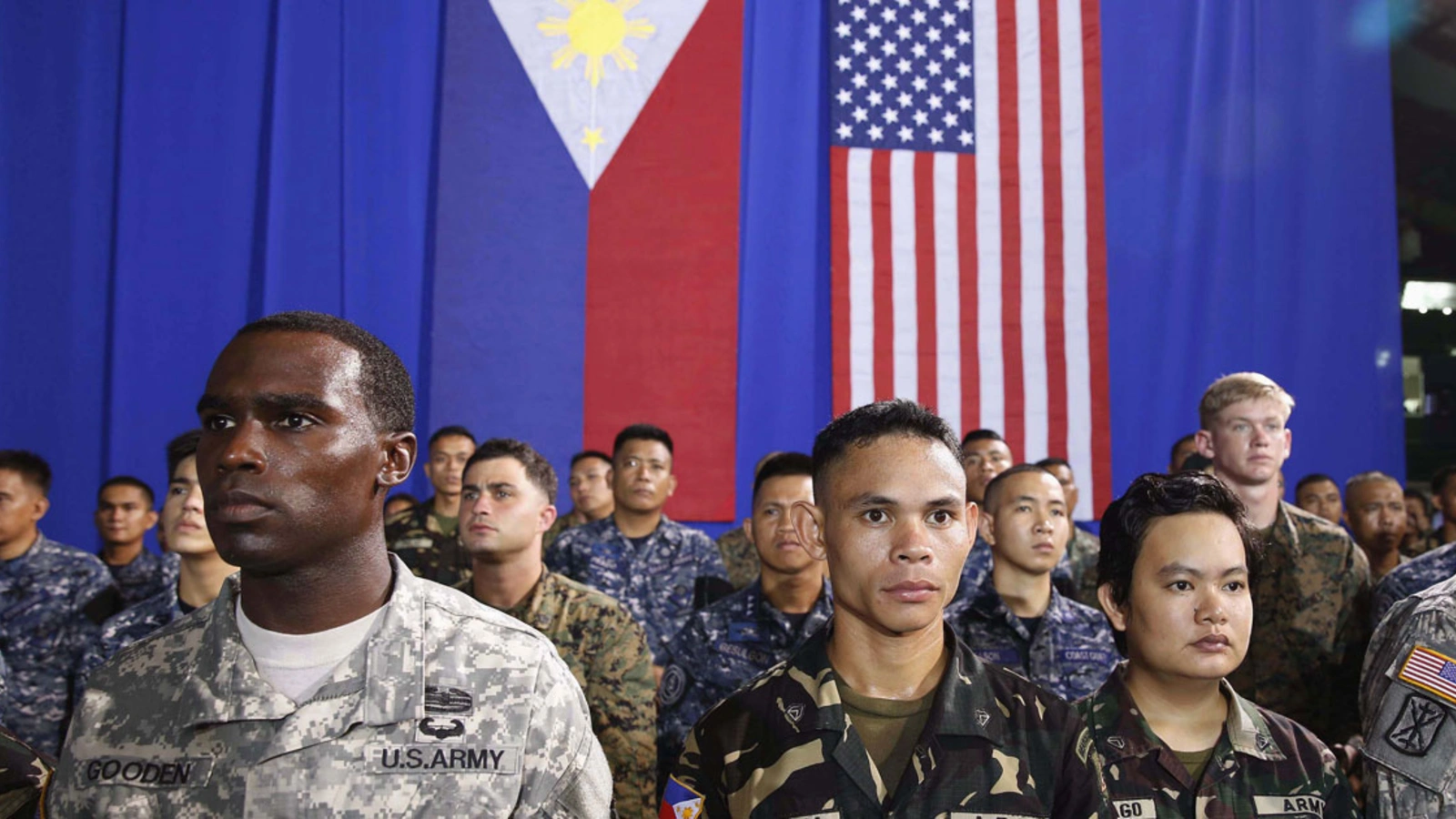
In 1992, the Philippine Senate voted against extending the U.S. military bases agreement, and GABRIELA became the first organization to issue an eviction notice to the U.S. Embassy. However, the Visiting Forces Agreement (VFA), signed in 1999 under the pretext of the “War on Terror,” allowed U.S. troops to return to the Philippines for “joint military exercises.” “The VFA is a 9-page executive agreement---signed by former U.S. President George H.W. Bush and former Philippine President Joseph Estrada---a mechanism deliberately structured to bypass senatorial ratification in both nations. This directly contravenes Article XVIII, Section 25 of the 1987 Philippine Constitution, which explicitly prohibits foreign military basing unless the agreement is approved by the Senate and correspondingly recognized as a treaty by the other state. In the United States, however, the VFA is dismissed as a mere executive agreement, devoid of domestic legal force. This legal loophole, affirmed by the 2008 Supreme Court ruling in Medellín v. Texas (which held non-self-executing agreements unenforceable in U.S. domestic law), lays bare the VFA’s inherent asymmetry: the Philippines is legally bound, while the U.S. retains the power to arbitrarily disregard its commitments.
The VFA permits over 5,000 U.S. troops to train 3,000 Filipino soldiers annually, raising questions: Why are there more trainers than trainees? Why is repetitive training yielding no tangible results? The answer lies in imperialist logic: the U.S. military uses this as a pretext for long-term presence to control Philippine resources, such as the oil and natural gas reserves in Mindanao (the Malampaya field, developed by Texaco and Halliburton). “Simultaneously, the VFA codifies the impunity of U.S. military personnel. It stipulates that American troops committing crimes on Philippine territory are remanded to U.S. custody---not Philippine authorities---for the entire duration of the judicial process. This provision effectively guarantees that justice is denied. Of 2,000 documented U.S. military crimes over the past century, only the Subic Bay case has ever reached a courtroom. Countless others---such as the fatal shooting of a scavenger boy or the death of a 14-year-old girl from a weapon wielded by a U.S. soldier---were summarily ‘settled’ with grotesquely trivial compensation, such as a dozen cans of sardines.” As Berna Ellorin, spokesperson for BAYAN USA, pointed out, this immunity perpetuates “a century of atrocities,” allowing U.S. soldiers to commit acts “from murder to gang rape” without being held accountable under Philippine law.
Anatomy of a Case: A Detailed Analysis from the Crime to the Subversion of Justice
The Subic Bay rape case occurred on November 1, 2005, at the former U.S. military base in Subic Bay, Olongapo City. This shocking and brutal case, which horrified the Philippines, involved a 22-year-old Filipino woman, Suzette Nicol (pseudonym “Nicole”), who had just graduated from university with a degree in Management Accounting, travelling from her hometown in Mindanao to Subic Bay to celebrate with friends. Nicole’s father had previously collaborated with U.S. forces, and she herself was engaged to a U.S. Army captain, which fostered in her a natural sense of trust and security towards American military personnel.
That evening, Nicole and her stepsister Anna Lisa were drinking at the Neptune Bar, where they encountered six U.S. Marines participating in the “Balikatan” joint military exercises: Daniel Smith, Keith Silkwood, Dominic Duplantis, Chad Carpentier, Albert Lara, and Corey Barris. They continuously plied Nicole with alcohol, forcing her to drink about 15 shots of hard liquor mixed with beer, rendering her utterly incapacitated. Upon leaving the bar, Smith carried the unconscious Nicole “like a prey” onto a rented Hyundai Starex van. The driver, Timoteo Soriano II, initially testified that the American soldiers took turns raping Nicole inside the vehicle, while the others allegedly jeered and encouraged, “Go on, Smith, go on!” Hours later, witnesses saw Nicole dumped “like a pig” on the roadside at Alava Pier, semi-naked, disheveled, with her jeans on inside out, a condom inside her underwear, and barely conscious. After being taken to the hospital, doctors confirmed severe trauma to her genitals and a blood alcohol level of 400-445 mg/dL, far exceeding the legal limit for intoxication.
An investigation was immediately launched. Feliciano Salonga, Chairman of the Subic Bay Metropolitan Authority, confirmed that the six U.S. servicemen had been identified by the driver. Although Nicole initially reported a gang rape, she was subsequently pressured to modify her testimony, identifying only Smith as the principal assailant and the others as mere accomplices. The U.S. military issued a categorical denial, countering with the claim that the act was ‘consensual ’. Two marines (Lara and Barris) were released due to lack of presence at the scene. The remaining four (Smith, Silkwood, Duplantis, Carpentier), although charged, were, under the provisions of the Visiting Forces Agreement (VFA), turned over to the custody of the U.S. Embassy. This blatant protection sparked national outrage, with groups like GABRIELA strongly demanding the Philippine government arrest the involved American servicemen.
In 2006, the trial lasted over a year at the Makati Regional Trial Court Branch 139. The central issue was whether Nicole was intoxicated to the point of being incapable of giving consent. Under the Philippines’ 1997 Anti-Rape Law, rape is committed if the woman is “unconscious or out of her senses.” Prosecution witnesses confirmed: a bar security guard saw Smith carrying Nicole away, and passers-by saw her being discarded. Toxicologist Dr. Kenneth Hartigan Go calculated the blood alcohol level, proving Nicole was completely incapable of consent. Smith admitted to sexual intercourse but cynically claimed it was “consensual.” The defense even resorted to the vile tactic of smearing Nicole as a “prostitute,” attempting to vilify the victim.
On December 4, 2006, Judge Benjamin Pozon convicted Smith of rape, sentencing him to reclusión perpetua (a term of 40 years in practice) and ordering him to pay 100,000 pesos (approximately $2,000 USD) in damages to Nicole. The other three were acquitted due to insufficient evidence. The verdict clearly stated that Nicole was intoxicated and incapacitated, rebuking the defense’s attempt to reframe the assault as a ‘romantic interlude,’ dismissing the narrative as patently absurd. By law, Smith should have been immediately incarcerated in a Philippine jail. However, after spending just 30 days in a Philippine prison, he was transferred back to U.S. Embassy “custody.” When Philippine police attempted to enforce the judgment, the U.S. Embassy deployed security to block them. The United States further threatened to cancel the 2007 “Balikatan” exercises and halt humanitarian aid. Facing this brazen blackmail, President Gloria Macapagal Arroyo yielded. On December 29, 2006, Smith was secretly returned to U.S. Embassy shelter, provoking public fury.
Smith filed an appeal. On March 12, 2009, a dramatic turn occurred: Nicole signed an affidavit stating she was “no longer sure she had been raped,” citing a “troubled conscience” and a desire “to move on with her life.” She subsequently dismissed her lawyer, Evalyn Ursua, and left the country to join her fiancé (records indicate she flew to Japan). The affidavit was immediately met with suspicion: Congresswoman Liza Maza decried it as the U.S. “buying her silence,” while Senator Jamby Madrigal pointed directly to an “offer she could not refuse.” Although Nicole’s mother denied external pressure, the public widely believed that she and her family had been subjected to immense pressure and potential payoffs. The driver, Soriano, also recanted his testimony, claiming he was “coerced by police into testifying.”
On April 23, 2009, the Court of Appeals (a division of three female justices: Monina Arevalo-Zenarosa, Remedios Salazar-Fernando, and Myrna Dimaranan-Vidal) astonishingly overturned the conviction and acquitted Smith. The cold-blooded decision declared “no evidence of force, threat, or intimidation,” distorting the brutal rape into a “spontaneous romantic interlude,” and even insultingly labeled Nicole as “reckless and wanton” who “actively flirted.” The court completely disregarded the lower court’s findings regarding Nicole’s incapacitation due to intoxication, revealing ruthlessly judiciary’s utter subservience to imperial interests. Smith was immediately released, swiftly repatriated to the United States, escaping all accountability, while the victim and the dignity of the Philippine justice system were utterly trampled.
GABRIELA’s Actions and Stance: Vanguard of Women’s Resistance
GABRIELA, established in 1984, is the largest women’s organization in the Philippines, dedicated to the struggle against imperialism, feudalism, and bureaucrat capitalism. It also founded the legal political party, the GABRIELA Women’s Party (GWP), to participate in congressional elections and advance women’s rights. GABRIELA views the Subic Bay case as a symbol of the oppression of women by U.S. imperialism and has organized sustained protests and advocacy.
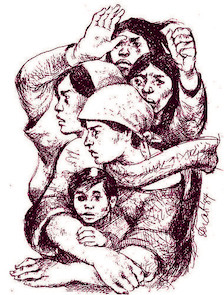
Following the incident, on November 5, 2005, GABRIELA and GWP protested in front of the U.S. Embassy in Manila, condemning the rape, demanding the withdrawal of U.S. troops from the Philippines, and calling on the government to arrest the six American soldiers. Members chanted, “U.S. troops, don’t touch Filipino women anymore! Junk the VFA!” They emphasized that this case was not isolated but a continuation of a century of humiliation by U.S. forces: from the brothels of the colonial era to the “rest and recreation” following modern-day military exercises.
In a 2007 speech, GABRIELA lead figure Ninochka Roscas (a former political prisoner) analyzed the case: U.S. soldiers exploited the vulnerable position of impoverished Filipino women, and the rape case exposed the Philippine government as a “puppet.” Roscas pointed out that the VFA allowed the return of U.S. troops, leading to a surge in violence, during which 800 activists were assassinated, including 40 from GABRIELA. She condemned the U.S. threat to cancel military exercises to pressure the Philippines into transferring Smith, demonstrating U.S. imperialism’s domination over the Philippine judiciary. Roscas called for the abrogation of the VFA and an end to the stationing of U.S. troops.
After Nicole recanted her testimony in 2009, GABRIELA and the New Patriotic Alliance (Bagong Alyansang Makabayan) petitioned the Supreme Court on May 24, demanding an investigation into the affidavit, suspecting corruption. Representatives Liza Maza and Luzviminda Ilagan (GWP representatives) drafted House Resolutions No. 458 and No. 1019, calling for the termination of the VFA, describing it as “debasing sovereignty and paving the way for the prolonged stay of U.S. troops.” Ilagan emphasized that prostitution stems from unemployment and economic deterioration, with U.S. troops exploiting women’s poverty for sexual exploitation: “the incidence of rape increases, but the victims are forced into silence.”
GABRIELA’s perspective is rooted in class and gender analysis: U.S. imperialism maintains poverty in the Philippines through economic aid (the Philippines is the fifth-largest recipient) and military presence, driving the sexual exploitation of women. The training of Filipinos by Blackwater for deployment to Iraq further integrates them into the imperial war machine. GABRIELA calls for addressing the prostitution with decent jobs, rather than relying on U.S. military “aid.”
Say No to Imperialism
The Subic Bay rape case is not an isolated incident but a reflection of a century of U.S. imperialist oppression against the Filipino people. From the crime to the acquittal, justice was perverted and the victim was forgotten. GABRIELA’s resistance keeps the flame of defiance alive. Abrogating the VFA and expelling U.S. troops is the only way to ensure Philippine sovereignty and women’s dignity. The Filipino people should no longer pay the price for imperial “entertainment”---as Roscas stated, the U.S. is “too greedy, too bullying.” Only through mass struggle can this oppression be ended.